How to set up a calm down corner kids will actually use
Most calm down corners don't fail on the first day. They fade. By October there's a beanbag, a basket of fidgets nobody touches, and a stack of chart paper someone parked there "just for now."
This guide is for PreK through 2nd grade teachers who are setting one up for the first time, or trying to bring one back. It's short on shopping lists and long on the stuff that decides whether kids actually use it.
What is a calm down corner?
A calm down corner is a small spot in the classroom where a child can go to settle their body when a feeling gets too big. It's a place to go, not a place to be sent. It isn't a timeout, and it isn't a reward for good behavior either. Any kid can use it, on any day.
Why most corners stop working
When a corner sits empty, it's usually one of five things:
- Nobody ever said out loud when kids are allowed to go. So it starts to feel like the place you get sent, and kids avoid it.
- Kids don't know what's in there. A basket with a lid is a mystery. A kid who's upset isn't going to dig.
- The child who needs it most won't go alone. That's normal. It means the adult has to walk over, at least the first time.
- It turned into storage. Extra supplies creep in and the corner stops looking like a place for kids.
- The adults aren't sure what to say once a child is sitting there. Honestly, this is the big one.
Every one of those can be fixed in an afternoon. None of them needs new furniture.
Where to put it
Put it somewhere a child can see from the carpet and get to without asking. A corner way across the room starts to feel like a timeout spot, even if you never meant it that way.
Hang the sign at kid height. If only the grown-ups can read it, it's really a note to yourself.
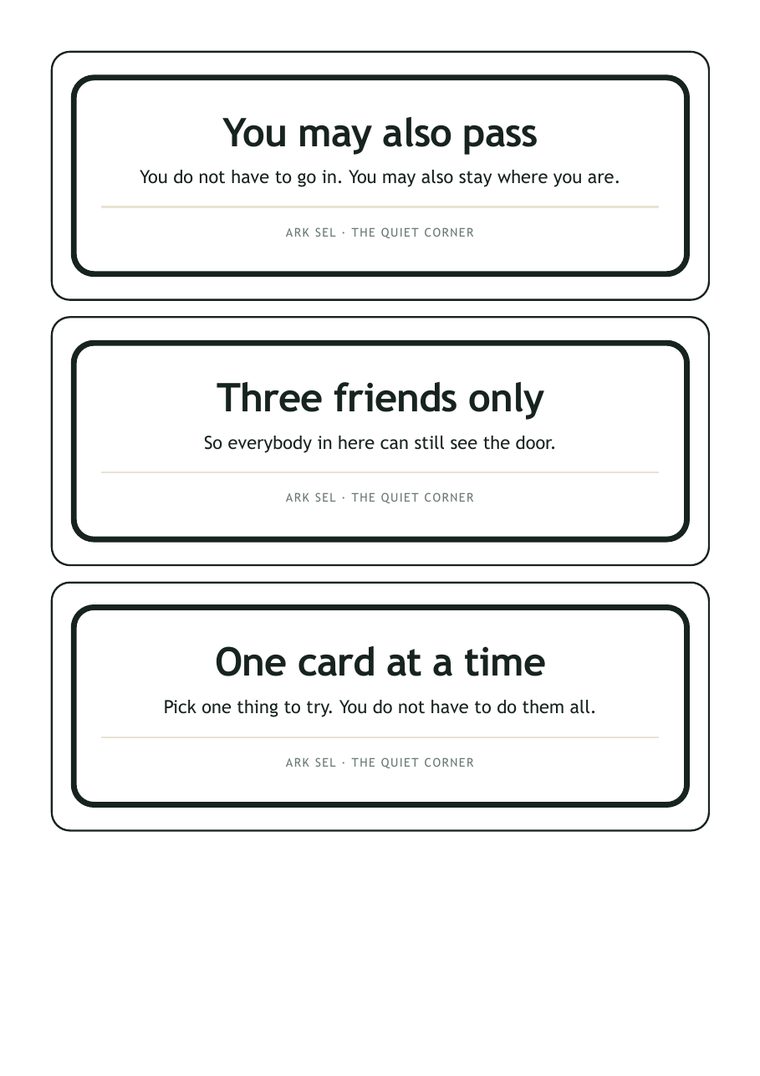
Keep it to three kids at a time. With three, everyone in there can still see the door and still hear you. Four starts to feel like a party.
What to put in it (less than you think)
Take out anything nobody has touched this year. Then put one thing on each surface instead of piling everything into a bin. A child in the middle of a big feeling won't rummage, so everything should be in plain sight.
Two items at a time is plenty. Swap them every couple of weeks. Here's an easy order to rotate through:
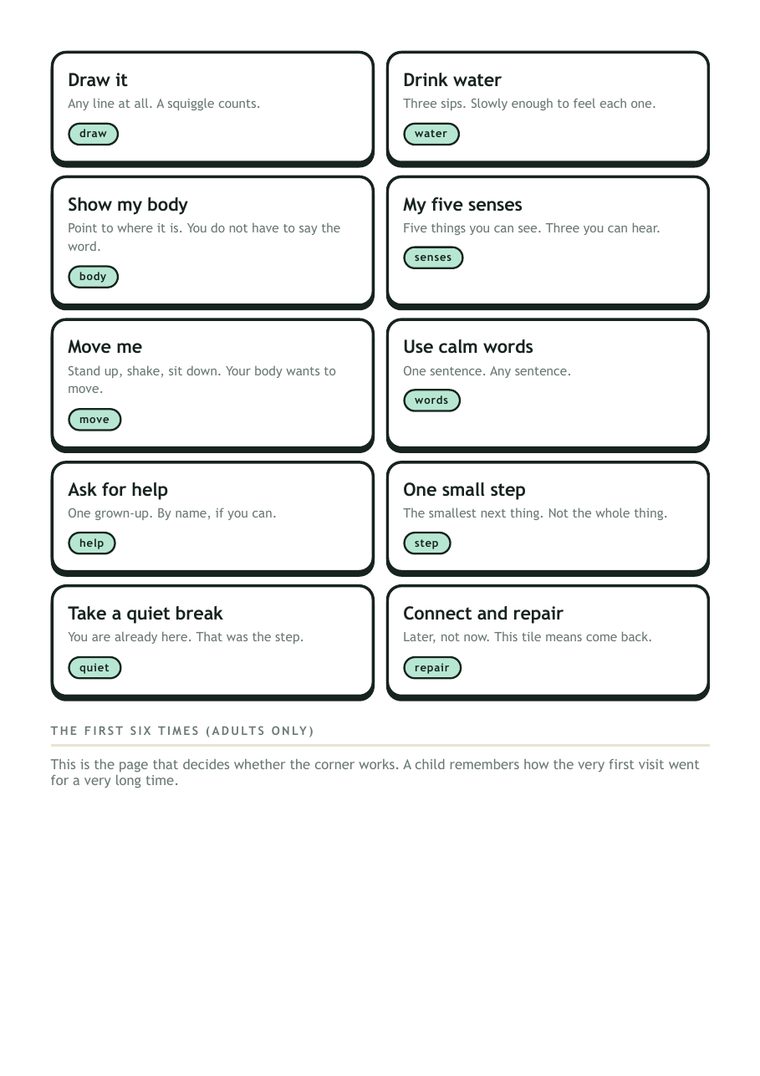
- Weeks 1-2: slow breathing and a drink of water (no equipment, nothing can go wrong)
- Weeks 3-4: drawing it out, and pointing to where the feeling is in your body
- Weeks 5-6: a five senses card and something to look at
- Weeks 7-8: counting to five and a movement card
- Weeks 9-10: calm words and asking for help (these need a grown-up nearby)
- Weeks 11-12: a quiet break and "one small step"
Then start over. If a kid is holding a card when the swap happens, let them keep it until they put it down.
And decide what doesn't go in there. No food, no worksheets, no screens, no other kids' things. Write that list on the sign so a sub or a para runs the corner the same way you do.
Rules for the grown-ups
The kids need maybe two rules. The adults need more, because we're the ones who accidentally turn the corner into a punishment.
- Kids can go on their own, any time, without explaining why.
- Never use it as a consequence. If a child gets sent there even once as a punishment, it gets a lot harder to convince them it's a safe place.
- No fixing yet. The corner is for getting the body calm. The talk comes later, back at the table, and only if they want it.
- They come back when they're ready. Not when you are.
- You don't have to say anything. Sitting nearby, quiet, where they can see you, counts.
- One card per visit. Not all of them. One is something a four-year-old can hold in their head.
What to say the first time a child goes
The first visit matters more than any of the others. Kids remember it.
Walk over, get down to their eye level, and say: "Good idea. I'll stay right here." Then stop talking for about a minute. Don't ask what's wrong. Don't hand them something. Don't leave.
A few other moments that come up a lot:
- A child refuses to go: "You can go, or you can stay here with me. Both are fine." Then keep teaching. If they wander over later, don't mention it.
- Another kid follows them in: To the follower, "You're allowed in here too." To the first child, "Three friends only, so everyone can see the door."
- They're crying in there: Nothing. Stay where they can see you. Crying isn't a problem you need to solve right then.
- You forgot the corner existed for three weeks: Don't relaunch it. Put out one new card, tell the class once that it's there, and move on.
When it already stopped working
Nobody goes. Check the sign first. Then ask yourself whether anyone has ever told the class, out loud, "You can go there whenever you need to." If not, that's probably the whole problem.
It's become a punishment. Stop it today, and say so in front of the class: "This isn't where you go when you're in trouble. Anybody can go here." Kids accept that pretty fast when they hear it from you.
Only one kid uses it. That's fine. That's one kid who has somewhere to go.
The adults run it differently. This one quietly kills a lot of corners. Put the rules on the sign and tell your para, your co-teacher, and your subs.
Free printables to get started
The free Calm Down Corner Setup Guide on TPT has everything above in printable form: the adult rules, 8 corner signs, a 5-level feelings meter that uses numbers instead of faces, the 12 choice tiles, the rotation plan, and what to say for the first six visits. It's 16 pages on US Letter (15 on A4), written for the adults.
If you want something the kids hold, the free Feelings Check-In has four feelings cards and three calm choice cards. When you're ready for more, the Calm Down Corner Kit ($5.50) adds 48 emotion cards covering 30 feelings, an emotion wheel, a feelings meter, and breathing tracing boards.
Questions teachers ask
How long should a child stay in the calm down corner?
The guide doesn't use a timer. A child comes back when their body feels smaller, not when they feel totally fine. Plenty of teachers do use a short timer, and if that works in your room, that's your call. Just keep it from feeling like a countdown to getting in trouble.
Is a calm down corner the same as a timeout?
No. A timeout is the adult deciding the child needs to leave. The calm down corner is the child deciding they need a minute. If it's ever used as a consequence, kids stop choosing it.
Do I need to buy anything?
Not really. A spot on the floor, a sign at kid height, and two printed cards will do it. Soft seating is nice but optional.
Does this work in PreK?
Yes. Keep it to one or two cards with pictures, and expect to walk over with kids more often at first.