What to say when a student melts down: 6 scripts for PreK-2
You know the moment. Someone's under the table, the read-aloud has stopped, and twenty kids are watching to see what you do next. Nobody comes up with the perfect sentence right then. That's why it helps to have a few ready before you need them.
Below are five things that matter before you say anything, then six scripts for PreK-2 you can borrow word for word. They come from our book What to Say When Students Melt Down, which has 60 of them.
Before any script
- Get down first. Get your body lower than theirs. A child who's upset is looking for a face, and if you're standing over them, the only face they see is one looking down.
- Name the feeling, not the behavior. "You're angry," not "you're being naughty." The feeling is allowed. It's also something you can work with.
- Say less than you think you need to. The urge to explain and teach right then is mostly us trying to get out of an uncomfortable moment. The child isn't asking for a lesson.
- Give the rest of the class a job. It isn't ignoring the child. It's how the room stays calm enough for them to come back to.
- Plan the repair. How you handle your own mistake afterward is what they'll copy.
Six scripts you can use tomorrow
Each one starts with a "say this first" line. Read it out loud, exactly, and you've bought yourself a minute to think. (The scripts are quoted as written in the book.)
1. The big angry one: kicking, throwing, knocking things over
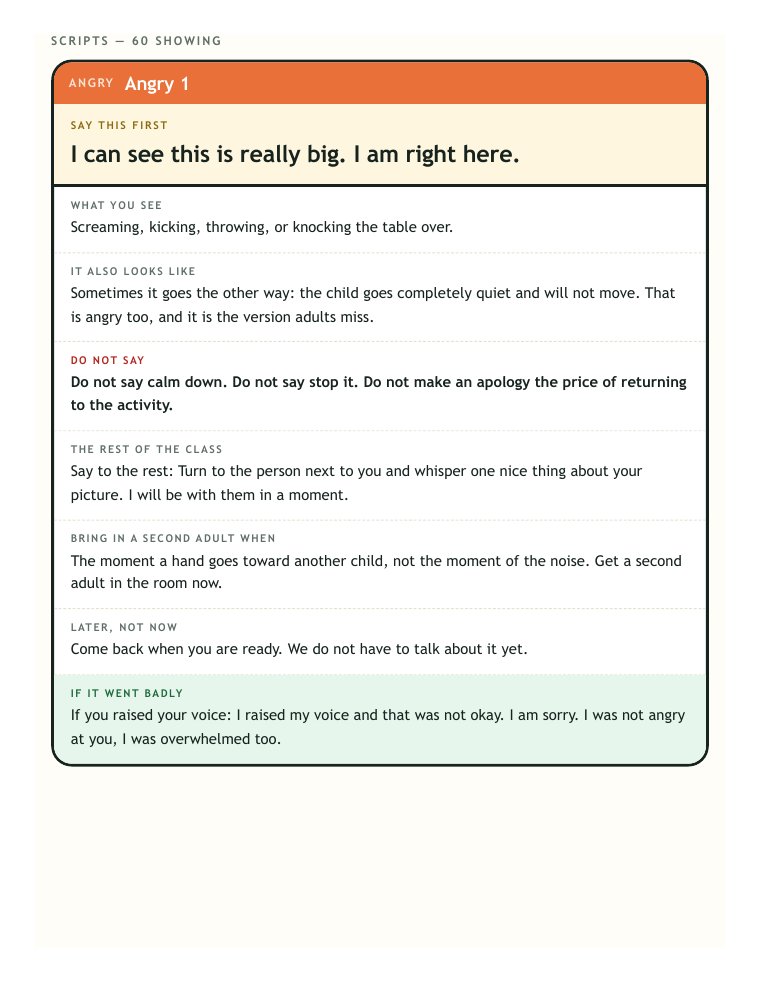
"I can see this is really big. I am right here."
Don't say: calm down, or stop it. And don't make an apology the price of coming back to the activity.
The rest of the class: "Turn to the person next to you and whisper one nice thing about your picture. I will be with them in a moment."
Get a second adult the moment a hand goes toward another child, not the moment it gets loud.
2. Angry at a game, a material, or a rule
"That is so frustrating. I would be mad too."
Don't say: it's not a big deal. To a six-year-old it's the biggest deal that's happened all day.
Later: "Want to try it again, or find a different one? You choose."
3. Angry at you
"It sounds like I did something you did not like. Tell me what I did."
This one gets called defiance a lot. Very often it's a kid who's scared of getting it wrong. Don't stack a consequence on top of the feeling.
4. Overwhelmed: everything at once
"This is too much. That is allowed to be too much."
Don't list what's coming next. A list of five things is five more things.
The rest of the class: one instruction, one job, nobody else talking for a minute.
5. Falling apart at every transition
"I know that was fast. I should have warned you."
Usually it isn't the change itself. It's that the change showed up with no warning. Teach the whole class a two-minute heads-up and the next transition gets easier for everyone.
6. Crying that won't stop, from a kid who doesn't usually cry
"You are really sad. I can see it."
Don't say cheer up, and don't offer a treat. That teaches a kid that sadness can be bought off.
The rest of the class: nothing. Let the room carry on being normal around them. That's comforting in itself.
Later: "You do not have to stop crying to rejoin us."
If it went badly
It will, sometimes. Every script in the book ends with a repair line for the adult. A few of them:
- If you raised your voice: "I raised my voice and that was not okay. I am sorry. I was not angry at you, I was overwhelmed too."
- If you called them out in front of everyone: "I singled you out and that was not fair. I am sorry."
- If you took it personally: "I am not upset with you. I am still your teacher and I still like you."
Kids learn more from watching you fix a mistake than from never seeing you make one.
When a script isn't enough
These are for the everyday hard moments, not emergencies. If a child is hurt, isn't responding, or tells you someone is hurting them, follow your school's emergency and safeguarding steps right away.
Want all 60?
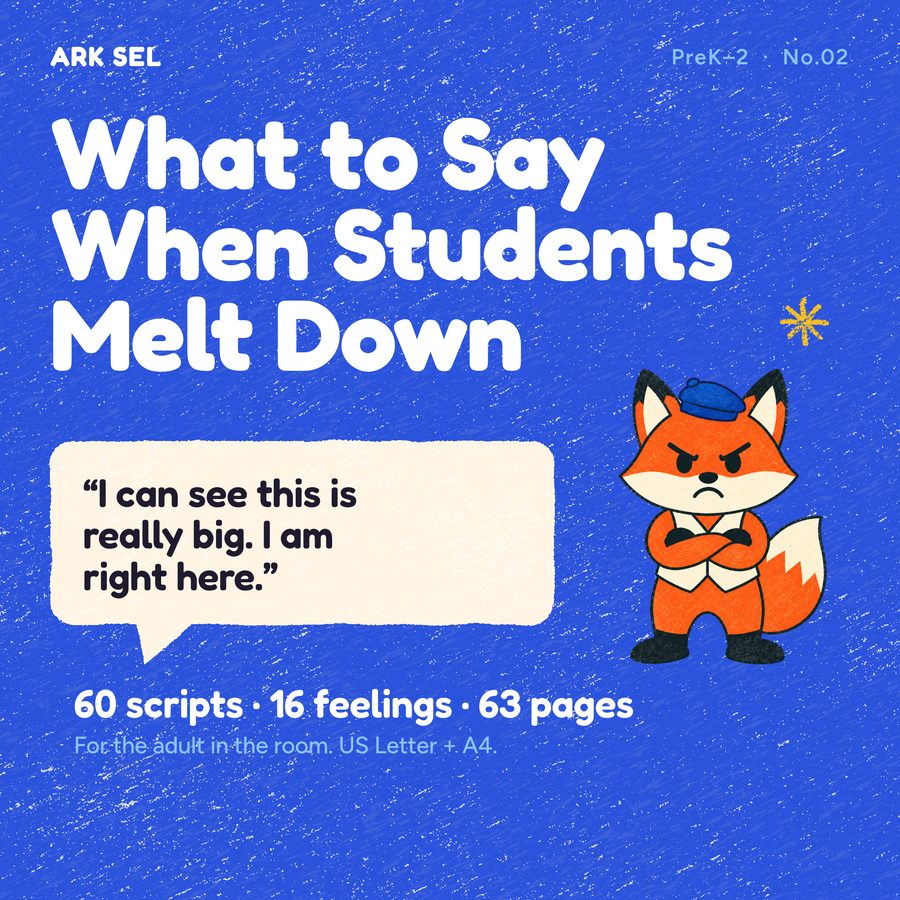
What to Say When Students Melt Down ($4.50) has 60 scripts sorted by 16 feelings, from angry and overwhelmed to shy, bored, and proud. Each one covers what to say first, what it looks like (including the quiet version that's easy to miss), what not to say, what to do with the rest of the class, when to get a second adult, and how to repair it. It comes as a searchable HTML file you can keep open on your phone, plus a printable PDF for your sub binder.
It's also part of the Calm Down Corner Bundle ($12), with the Kit and the bilingual family letters.
Questions teachers ask
What should you not say to a child having a meltdown?
Skip "calm down," "stop it," "it's not a big deal," and "there's nothing to be scared of." They tend to make the feeling bigger, because the child hears that you don't believe them.
Should I talk about what happened right away?
Not yet. Get the body calm first. The conversation comes later, when they're back, and only if they're up for it.
Are these scripts for kids with IEPs or behavior plans?
They're general classroom language. If a child has an IEP or behavior plan, follow that plan first.