Notes home after a hard day, in English and Spanish
Calling home after a hard day is tough. It's tougher when the family reads Spanish and you don't. A short, calm note that goes home the same day can do a lot of the work for you.
Here's how we write notes home about feelings and behavior for PreK-2 families, with an English and Spanish example you can copy.
What a good note home says
Keep it to three things:
- What you noticed. Describe what happened, plainly. "When the plan changed, your child's hands squeezed tight and they hit the table."
- What you're already doing about it. Families relax a lot when they hear the school already has a plan.
- One small thing to try tonight. One. Not a list.
That's the whole letter. It doesn't ask the family to run a program at home, and it doesn't hand them homework.
Words to leave out
Skip words like bad or problem. Plenty of parents stop reading the second they hit one of those in a note from school. Say what happened and leave the label off.
Also leave out anything that sounds like a diagnosis. You're describing what you saw in class, that's all. If you think a child needs more support, that goes through your counselor and your school's process, not a take-home note.
An example (English and Spanish)
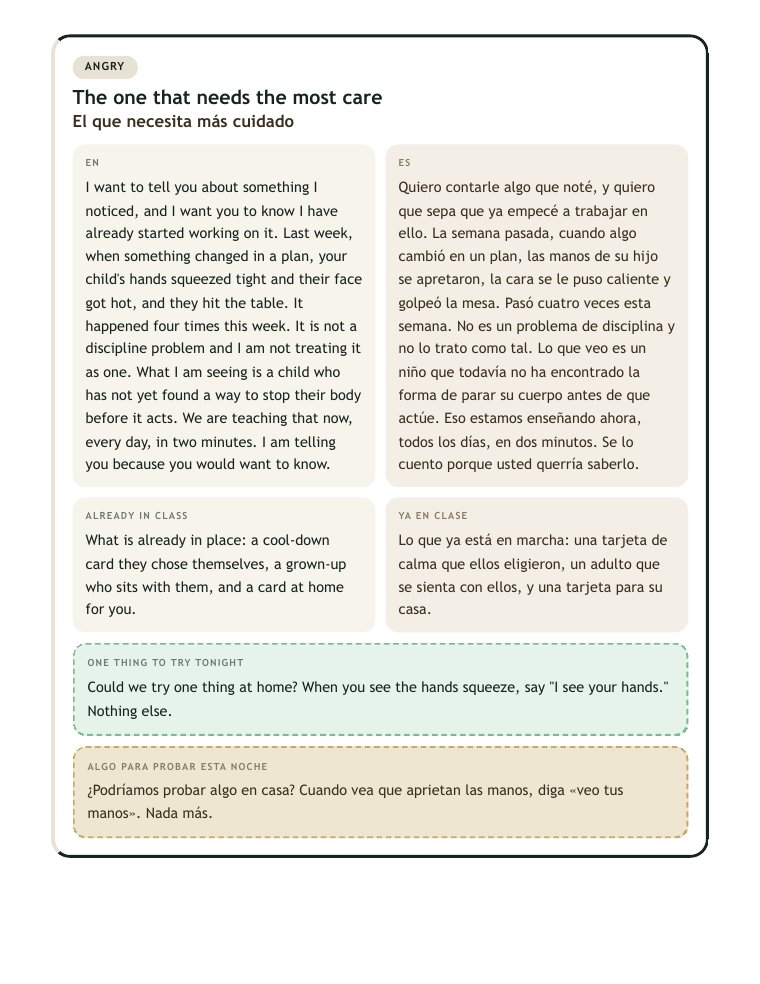
This one is from the "angry" letter in our family letter pack. The "one thing to try tonight" section reads:
"Could we try one thing at home? When you see the hands squeeze, say 'I see your hands.' Nothing else."
"¿Podríamos probar algo en casa? Cuando vea que aprietan las manos, diga «veo tus manos». Nada más."
Notice how little it asks for. That's something a worn-out parent can manage at 6 p.m.
Send good-day notes too
When every note home is about a bad day, families start to dread opening the folder. Send a quick good-day note when something goes well, even something small like a kid who took a breath instead of shoving. Then when you do need to send a hard one, they already know you're on their kid's side.
Make it fast enough to actually do
- Keep the letters handy, either on your laptop or printed in a folder at your desk.
- When something happens, pick the letter for that feeling, copy it into your own doc or parent app, and swap in what actually happened.
- Send it the same day. A note about Monday that shows up on Thursday just doesn't hit the same.
- Your school probably has rules about what can go home in writing and what needs a call or a meeting. Follow those.
Be ready for the questions parents ask
Once a note goes home, you'll probably get a reply or a quick question at pickup. The same few come up again and again, and it helps to have an answer you've thought about. Two from our pack:
"Is my child in trouble?"
"No. Your child is not in trouble. I am writing because I want you to know something I saw, and because there is one small thing that would help at home."
"What do I do tonight?"
"Ask one question: how was your body today? Then stop talking. You do not need to solve it, and you do not need to get a story out of them."
The pack has those answers in English and Spanish too.
The letter pack
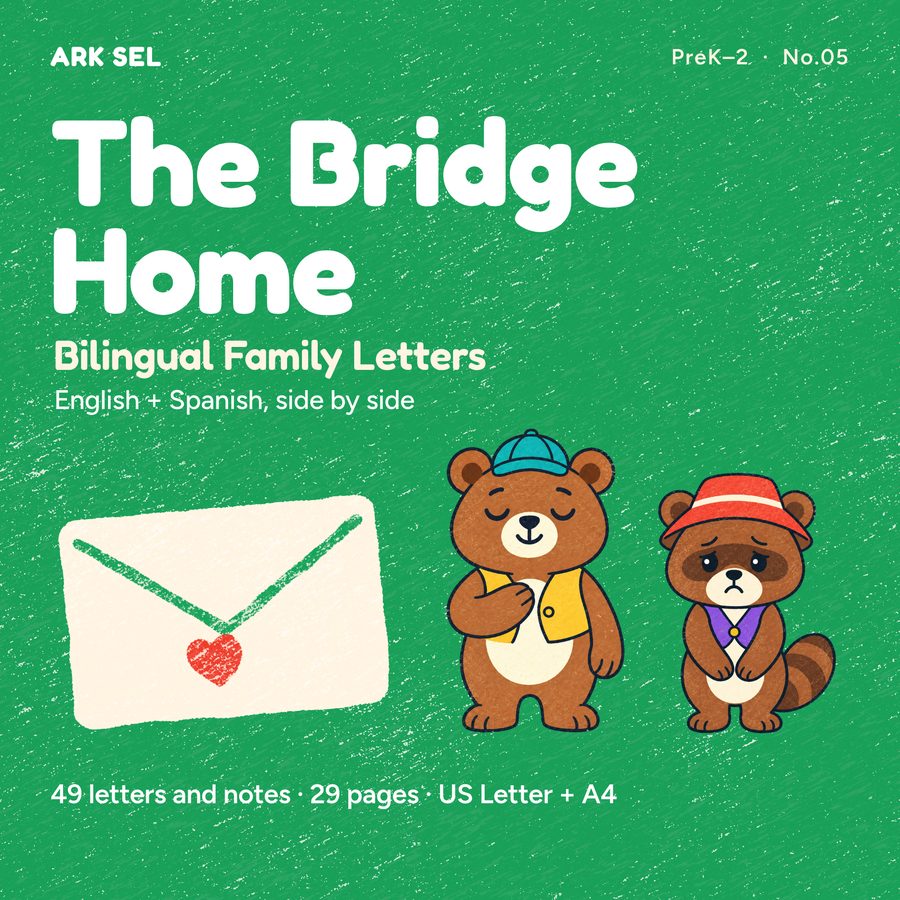
The Bridge Home ($3.99) is 29 pages of family letters with English and Spanish side by side: 13 letters for hard days (angry, overwhelmed, lonely, embarrassed, and more), notes for the good days, the ten coping strategies rewritten as things a family can do in a normal evening, and answers to 10 questions parents often ask. Every letter is written out in full, so you just read it and change the details for your student. It comes as a printable PDF in US Letter and A4, plus an HTML version.
It's also in the Calm Down Corner Bundle ($12) with the Kit and the meltdown scripts. If you want to see our style first, the Feelings Check-In is free.
Questions teachers ask
Should I translate notes home myself with a translation app?
For anything about a child's behavior or feelings, a person who reads the language well should check it if you can. Small wording differences matter a lot in these notes.
How often should I send notes home?
There's no magic number. A good rule is to send at least as many good-day notes as hard-day ones.